Skip to content

Madhuban (Forest of Honey)
At the heart of Mount Abu sits Madhuban, the legendary “Forest of Honey.” It is a sprawling campus high in the hills, renowned as the Brahma Kumaris’ spiritual capital. Generations of pilgrims and seekers describe Madhuban as charged with a “subtle spiritual energy”, offering an experience of inner peace and joy that’s hard to find elsewhere. Over 35,000 guests come here each year to attend courses, retreats, and daily meditation, and about 500 permanent residents maintain the campus operations. The name “Madhuban” reflects the sweet fruits of self-awareness that students aim to develop in this tranquil setting.
Several sacred sites at Madhuban are especially significant. Baba’s Hut and Baba’s Room commemorate Prajapita Brahma (also known affectionately as “Brahma Baba”), the founder of the Brahma Kumaris. Baba spent years meditating intensely in this modest hermitage, “spreading subtle rays of peace to all souls of the world” through his focused spiritual practice. Nearby is the Tower of Peace, a white marble memorial where the mortal remains of Brahma Baba were laid to rest.
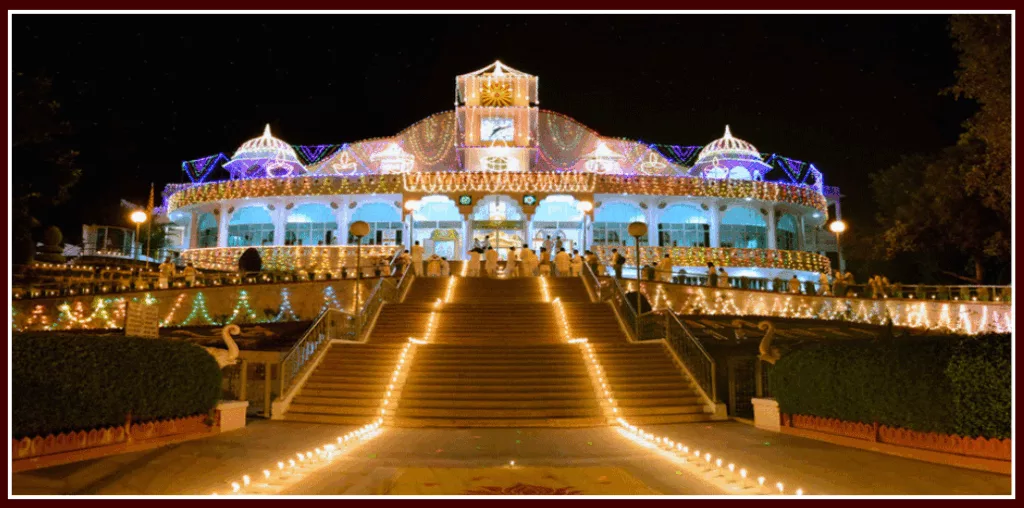
The campus also features the Om Shanti Bhawan (Universal Peace Hall), the main auditorium (shown above). This attractive, free-spanning hall holds about 3,000 people and provides translation in 16 languages. Since its opening in 1983, Om Shanti Bhawan has been the site of global conferences and spiritual gatherings.
On any given day at Madhuban, the sweet chant of mantras drifts through the air as attendees meditate in silent groups or attend lectures on Raja Yoga philosophy. The community maintains meticulous gardens, laundry, and dining services for thousands of people, yet the overall pace remains calm and caring.
Simple sattvic (pure vegetarian) meals are prepared for up to 4,000 people at a time, and traditional sweets and tea are offered to visitors. Walking the campus paths, one may see raglan-dressed Kumaris (women students) carrying wooden buckets of flowers, or a group of pilgrims practicing pranayam breathing under a banyan tree. Despite the crowds, Madhuban never feels chaotic; it is a living ashram dedicated to collective meditation and service.
Gyan Sarovar (Lake of Knowledge)
Just a few kilometers from Madhuban lies Gyan Sarovar, or “Lake of Knowledge.” Built starting in 1991, this beautiful 28-acre campus was envisioned as an Academy for a Better World, a modern learning community where people of all backgrounds can study moral and spiritual values. The official name is Gyan Sarovar Vidyapeeth, and the setting is deliberately tranquil: landscaped gardens, orchards, and even man-made lakes cover much of the grounds. In fact, only about 12% of the land is built upon, so the rest remains as open green space to be enjoyed as a rural retreat.

The facilities at Gyan Sarovar support large gatherings and international programs. A standout feature is the Universal Harmony Hall, an auditorium that seats 1,600 and provides simultaneous translation in 16 languages. Adjoining this is the International Spiritual Art Gallery, displaying peace-themed art, sculptures, laser shows, and multimedia on spiritual subjects.
There is also an International Centre for Higher Learning with 13 seminar rooms, and residential buildings that can house over 1,500 students, teachers, and guests. Kitchens and dining halls cater to up to 1,200 people at once, serving wholesome meals that align with the movement’s sattvic diet.
The campus is almost off-grid: rooftop solar arrays and small wind turbines power the lights, computers, and telephone systems. An innovative wastewater treatment plant can process 200,000 liters of wastewater daily, recycling about 80% of it for irrigation. Food is grown on-site as well: three large lakes supply water to 15,000 fruit and vegetable trees planted around the campus.
This blend of eco-conscious design and spiritual purpose was internationally recognized. In 1996, the Gyan Sarovar Academy was showcased at the UN-Habitat II conference as a “Best Practice” model for human settlements.
Shantivan (Forest of Peace)

About 6 km from Abu Road, Shantivan (literally, “Forest of Peace”) emerges on the left side of the highway as a wide, open campus. It was created in the mid-1990s to accommodate the Brahma Kumaris community’s growth, providing a venue for large conferences, retreats, and educational programs.
The centerpiece of Shantivan is its Diamond Hall, an enormous, dome-like structure commemorating the organization’s 60th anniversary in 1996. This elegant hall, with no internal pillars to obstruct the view, can hold about 20,000 people. It is used for mega-conferences, festivals, and silent meditation events, where thousands gather in perfect stillness, absorbing guided thoughts on peace and unity.
Next to the Diamond Hall is a Conference Hall seating 1,200, with six-language translation facilities. Surrounding these are six smaller halls (each for 350 people) for seminars and workshops, plus two quiet meditation halls and a museum of spiritual artifacts.
A prominent building called Gyanamrit Bhawan (House of the Nectar of Knowledge) serves as the campus printing press. It is here that the Brahma Kumaris publish their two monthly magazines, Gyanamrit and The World Renewal, as well as hundreds of books and lesson materials.
Today, Shantivan is known to many as the world’s largest pillar-free meditation hall complex. A photograph of 20,000 silent meditators sitting in the Diamond Hall has circulated widely, symbolizing global unity.
Brahma Kumaris Peace Park
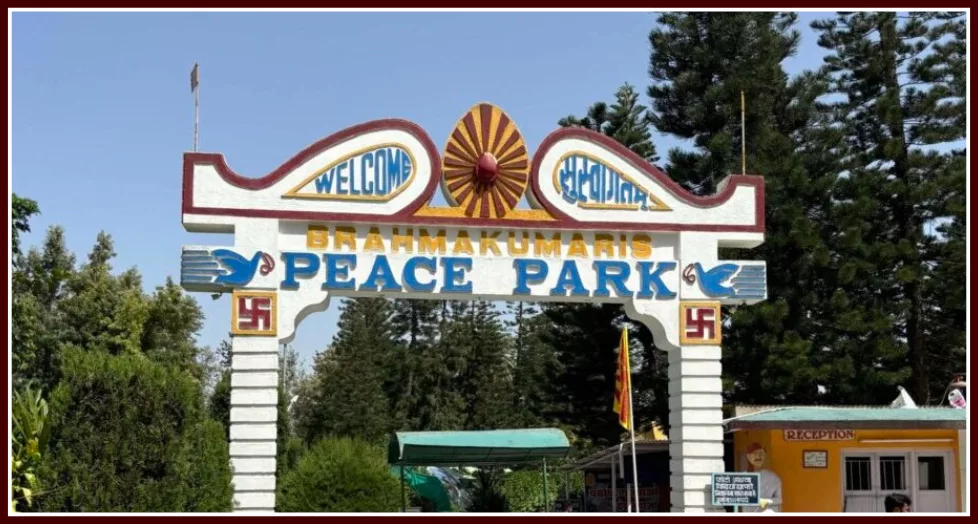
About 8 kilometers from Madhuban, set between two pilgrimage peaks (Guru Shikhar and Achalgarh), lies the Peace Park. Unlike the structured campuses, the Park is a natural oasis dedicated to silence, meditation and subtle learning.
It is lovingly tended by Brahma Kumaris volunteers, who greet thousands of visitors each day. The atmosphere here is hushed but joyful, combining a botanical garden with spiritual exhibits.
Upon entering, guests first encounter a rock garden bursting with succulents and Himalayan flora. Winding paths lead through citrus groves, ornamental flowerbeds, and an exquisite rose garden. Sculptures and benches along the way invite contemplation.
Informational placards explain how each plant or design element carries a symbolic meaning (for example, the charkha wheel representing life’s cycle). Every corner of the park is intended to awaken an inner connection with nature and the soul.
Inside the Peace Park is also a small auditorium and a visitor center. Here, a short film plays, highlighting the beauty of the human spirit and offering an introduction to Raja Yoga meditation. Visitors can relax and learn about spiritual concepts in any language before venturing outside. For those who wish to try meditation on the spot, the Park provides several tranquil huts: a traditional grass hut, a stone cave replica, and a bamboo meditation hut.
Infinite Spiritual Lifestyle – A Modern Spiritual Community
Nestled on Abu Road, just a short drive from the Brahma Kumaris campuses, is Infinite Spiritual Lifestyle (ISL), a new residential community built for mindful living. Billed as a “first-of-its-kind” development, ISL offers fully-equipped living spaces, healthcare, and wellness amenities on a landscaped campus. It is designed for people who want to immerse themselves in the spiritual environment of Mount Abu long-term, whether retirees, families, or spiritual seekers.
Whether you’re planning a weekend retreat or a lifelong journey, ISL invites you to step into a tranquil lifestyle untouched by the outside world.
Frequently Asked Questions
What is Madhuban (Forest of Honey)?
Madhuban is the Brahma Kumaris’ international headquarters in Mount Abu, India. It literally means “Forest of Honey”, symbolizing the sweet fruits of spiritual practice.
What programs does Gyan Sarovar offer?
Gyan Sarovar is a residential spiritual academy known as the “Lake of Knowledge.” It offers multi-day courses and conferences for the public on subjects like meditation, leadership, and conscious living.
What is special about Shantivan’s Diamond Hall?
The Diamond Hall is a massive, dome-shaped meditation hall at Shantivan, built in 1996 for the Brahma Kumaris’ 60th anniversary. It can hold about 20,000 people, making it one of the world’s largest pillar-free halls.
What can visitors do at the Peace Park?
The Peace Park is a landscaped spiritual garden open to all. Visitors stroll its rock gardens, orchards, and rosebeds while practicing mindfulness.